vaRLington, TX.
Yokozuna Hidenoyama Raigoro Entering the Ring by Utagawa Kunisada I (Toyokumi III)
Edo Period (Early 19th Century) National Diet Library
Public Interest Incorporated
As terrible as it was, atonement was to hand. He had arrived on this day with the sincerity of accuracy and a suitcase. The tanto, now removed from his uniform, is dispatched with impeccable mechanics and fulfills its function: seppuku. Self-disembowelment.
Slumped into the salt, he accepts his mistake. The black mark. The gyojī, a product of his stable, a disciple of harmony, and now at this tragic moment, his own priest.
This account of gruesome restorative justice is a work of pure fanfiction. To date, there have been no documented occurrences of sumo referees (Gyojī), committing ritual disembowelment in the wake of a bad decision. Nowadays, the act of seppuku has been replaced by a more tempered approach. The modern form of disembowelment is carried out by tendering a conventional resignation to the Public Interest Incorporated Foundation Japan Sumo Association. This request is usually rejected by JSA’s leadership who favor suspension, demotion, and most devastatingly; performance improvement plans, in order to preserve honor. A decent compromise. This reality is markedly less poetic and sensational, but the ritual functions and iconography remain magnificent.
Dew-Gatherer
The gyojī is responsible for a number of religious and combat functions that often intertwine.
Aspiring referees apply to enter the profession in their late teens. If selected for this elite group of 45 referees by the JSA, the referee is assigned a stable. Gyojī are integrated into the sumo wrestler’s (rikishi) training cohort and living situation (stables) in a way that has no comparison in world sport (Imagine the legendary italian soccer referee, Pierluigi Collina, setting off as a teenager to live and train in an Italian villa with S.S. Lazio for example) At the stable, they assume their referee name. Their first name will be their given name or one based on the characters of it. As they progress through the ranks, they will assume elevated status and are given sequential names of importance to that stable or inherit names from well-respected, outgoing referees, who are forced to retire at 65. Referee ranks correspond with sumo wrestler ranks. There are eight ranks in total with the top rank shared by no more than two senior referees. Those guys get all the high visibility gigs, but they can’t get too cozy, as a yearly relegation is just as likely as promotion within the ranks of the sumo gyojī.
To a modern grassroots referee, many of these concepts are completely alien. On any given Sunday morning I have been adorned with many brilliant and clinically considered names by coaches, players and fans- none of which I can tastefully list here, but I assume they didn’t share the great honor intended with the stable names given to the gyojī of the JSA. Vocational oddities, naming conventions and living quarters aside, sumo refereeing and the drearily-sober refereeing conventions of Europe and North America further diverge when considering the theological functions of the gyojī.
Grounded in the Shinto system of belief - the gyojī plays an integral part in facilitating its spiritual practices within sumo. Shinto itself is inconveniently and innovatively ambiguous in form. It could be crudely described as a practice that venerates Japanese ancestral lineage. There are central entities called Kami- which can take the form of anything from forces of nature, mountains, trees, and even successful people. Kami are considered amoral and function as a connection between the physical and spirit worlds.
The gyojī preside over the throwing of salt by the rikishi, which is a purification of the ring and considered a prayer for safety. They write calligraphy and perform ritual functions both in the community and ring. The gyojī carries a fatal, even spiritual, weight on his decision making. In the traditions and theatre he uses to officiate, he beautifully mirrors his human fallibility against an unreasonable and unattainable expectation of complete accuracy.
This shamanic style activity may provide a slightly odd, but curious lens to help us discuss the influence of video technology on criticism of contemporary sports officiating and its role in dissolving the role of the reliably fallible ref. It’s not that woo-woo. It points to a basic disconnection- where sport no longer accepts inaccuracy and being human is continually less tolerated.
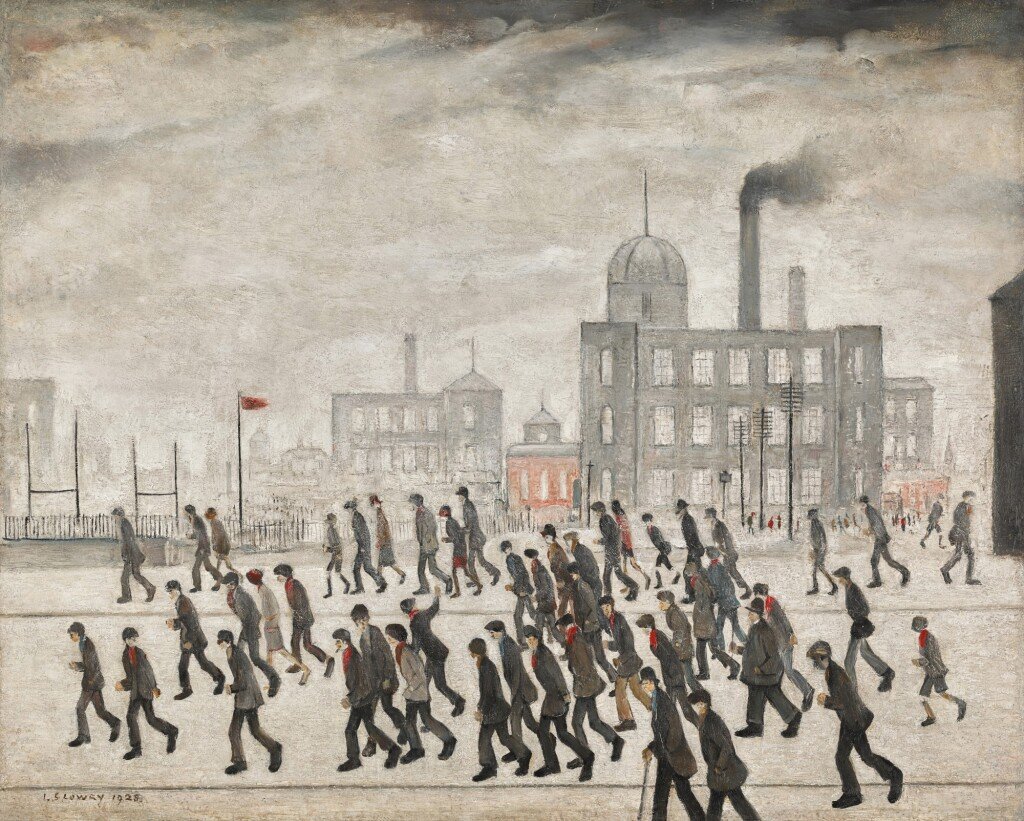
L.S. Lowry, Going to the Match, 1928.
Pub-Talk
If you were generous enough to engage me in some un-Googled, un-interrupted and un-derwhelming pub-talk and ask me why you should see sumo refs as anything other than a kind of cool cultural curiosity- I’d tell you to relax, I’m getting to it. But before that, I’m obliged to tell you that I heard an interview somewhere, with an English Premier League fan, who mentioned that after the introduction of Video Assistant Referee (VAR) and its increasing interference within the game, that he and many other fans, were likely just months away from not bothering to celebrate goals in the moment anymore.
I’d follow this up by questioning why media discussions around VAR give prominence to the voices of those with suspect investment in media and professional officiating organizations while also asking, with visible annoyance, why VAR is discussed under the affected assumption that it’s irreversible and will surely improve with inevitable updates and innovation. I’d raise suspicion around the overall take continually peddled by TV pundits as being fatalistic.
To qualify this, I’d conflate it with an equally vague account of an artist who had worked with football fans and ultra groups as part of her work. If I remember correctly, the artist recalled a participant who told her that the football terraces of 90’s England were the only places he’s had in his life to sing, hug and celebrate with his friends after big moments and goals. This euphoria helped him simultaneously break out of the unspoken boundaries set by his culture while still remaining within the grace of them.
Taking a look at the last mouthful of ale in my now tilted glass, I’d say something profound like “that’s sad that we've gone from theater to buffering”. With that, you would presumably nod in agreement, while suppressing the urge to call me a Luddite, to indicate I could shut up now.
In thinking about this loss of human enjoyment to VAR, I’m hesitant to co-opt sumo unequivocally into my technoskepticism. In fact, sumo had introduced human checks on the gyojī in the form of ring judges, and ex-wrestlers long ago. It has also used video monitoring of decisions in real-time decades before European and North American implementation. This followed a massive fuck-up in 1969 that incorrectly ended a 45 match winning-streak for Yokozuna Taihō. Ironically, video review was introduced because the referee had made the correct call- which was incorrectly overturned by the ringside judges. It hurts to think that the action of incorrectly overruling the human ref became a reasoning unto itself. A fitting allegory around the pressure we put on ourselves to be accurate.
At the heart of the arguments for introducing the video assisted referee to either confirm calls or second guess officials is this misguided insistence on accuracy. Without going completely off track and debating the possibility of accuracy being remotely achievable in officiating, and identifying it as a substitute for an even more problematic demand of sports pundits: consistency- let’s assume, in good faith, that we are aiming for accuracy. How much of ourselves are we willing to sacrifice to achieve it? At what point will we find the right mix of human and machine?
For me, the cost had been clear from a young age after I overheard an exchange at a local soccer match, an unfamiliar face in the crowd a few bodies away had responded to their friend that they didn’t immediately know what to think about a questionable non-call by the ref. They said to their friend that they naturally paused to wait on ‘the replay’ despite there having never been a Jumbotron at any league ground in that country. His exposure to televised repeats and frame-by-frame assessments had caused him to glitch. It remains one of the saddest things I’ve ever heard.
The intrusion of VAR in officiating is not a new crisis, it’s been increasing year by year for decades. It started with confronting the anger surrounding referee mistakes and a discomfort with ambiguity in high impact moments. Unfortunately, it developed into an unhealthy obsession with accuracy and perfection. It may come as a shock to many fans given the volume of media criticism aimed at referees, but pro-level officials across all the major soccer associations were already impressively accurate prior to VAR and similar systems. EPL, UEFA and FIFA studies claim that officiating accuracy over the past decade, prior to VAR, was in the 85-90%+ bracket for all national leagues and international competitions. The Premier league and the Professional Game Match Officials Limited (PGMOL), provider of referees to the EPL in England, have claimed that post VAR accuracy is now around 96%, the Professional Referee Organization of Major League Soccer in the U.S. report a similar stat, claiming an initial rise from 90% to 96% post VAR implementation. Given these stats, can it be reasonable that fans care so deeply about correcting that 6% that they are willing to have the flow, enjoyment and humanity extracted from the game? If so, we should have no surprise when the AI sponsors of professional sports leagues creep in to take care of that remaining 4% and declare victory on behalf of sports fans everywhere. FIFA are already hyping up how accurate decisions will be with an AI trained VAR for the upcoming 2026 World Cup.
Nokotta!
So what sort of sinister entity should we be worried about here? Is it a sort of relatable mustache-twirling, cartoon villain with a filthy laugh? Or is it an Umbrella Corporation, Omni Consumer Products, Cyberdyne Systems type deal that ultimately causes mayhem through catastrophic negligence or pure, ideologically driven, evil?
VAR’s story arc is probably a mix of both. What we do know about its evolution is that video refereeing likely started out as a well meaning attempt of increasing accuracy, arbitrating fairness and lessening frustration. It then stumbled, and continues to, due to a lack of immediacy and inability to adequately sync with its human handlers. Its faults were exposed and exacerbated by its fast-tracking into the highest levels of sport where it was sold as a bulwark against potential income loss for clubs missing out on progression into profitable and prestigious competitions, alongside the promise that it would quickly advance to ensure an aggravation-free game day experience for fans. The opposite happened. Skepticism grew due to depleting enjoyment and social lag.
In 2026, VAR has been pushed beyond its initial edict of correcting clear and obvious errors in high stakes games into non-critical decisions that frustrate fans while never quenching the induced thirst for accuracy that industry figures say gave it its terrible mandate: to increase our refereeing contentment.
Predictably, the detachment from the passion of the stadium has been optimised over recent years- even for the referees who operate the tech and communication mechanisms of VAR. Where once the review booths were retrofitted into vans and parked in the stadium parking lots, in the US, the PRO have centralized all VAR operations to an undisclosed location just outside of Dallas known as VARlington, Texas. While there’s no faulting the clever naming, I presume the vibe inside such a building is close to that of an insurance brokerage.
This bureaucratic optimization has led to the pro game becoming unrecognizable in both experience and rules, to not only lower league professional clubs who can’t afford or install it for various reasons, but also the Sunday league fields of the Black Country and the canchas de fútbol of Buenos Aires. It has created two forms of soccer. This insidious weaving tech into the fabric of the game denies the human connection to it. This is the ROI of complete accuracy.
So what kind of ref promotes ambiguity over accuracy? Perhaps one that sees it makes no worthwhile improvement to the official’s accuracy- only adjusting the adequacy of that specific outcome. Perversely, as the ex-pro FIFA and EPL referee Mark Clattenburg has stated, it may even make refs lazy, or at worst, secondary to the entire process. Not to say that video shouldn’t play a part in the training of refs to enhance their awareness or situational positioning, but to have tech deny or compromise human inaccuracy, to the point you are attempting to eradicate frustration, and its strange bedfellow, exhilaration, from sport- is to deny human nature.
Perhaps what feels reassuring about sumo‘s approach is its intentionality in its extreme and macabre interpretation of the importance of accuracy in adjudication – without abandoning the recognition that it is ultimately impossible in sports refereeing, restricting its video review process effectively to not allow interruptions to the sport and shatter the theatre and philosophical balance that has long enhanced the sport’s individuality. To argue the timing formats and difference in flows between sumo and team sports lend themselves more easily to less interruption may miss the point completely and derail from the underlying issues with VAR as a practical approach to the topic of accuracy.
Sumo’s continued embrace of conflicting opinions and intentions has allowed the gyojī to continue to operate in harmony with ambiguity – seeing it as a valuable, inevitable and succinctly human asset. The iconography and theater that the gyojī carries himself with directly confronts this dilemma, without the foolishness and brash insistence of thinking it solvable- saving its refereeing heritage from what we have seen become a loveless abattoir of buffering emotions in modern soccer stadiums.
The tradition of the sumo gyojī can help frame our consideration of ‘progress’ in the moral virtues, respect and ambiguity that were once central to the core experience of sport in an increasingly inhuman, artless and dystopian future that is being prescribed for sports fans and our referees. A world where everything looks worse in slow-motion.
Rob Murphy
