performance journaling
practical self-evaluation for sports officials
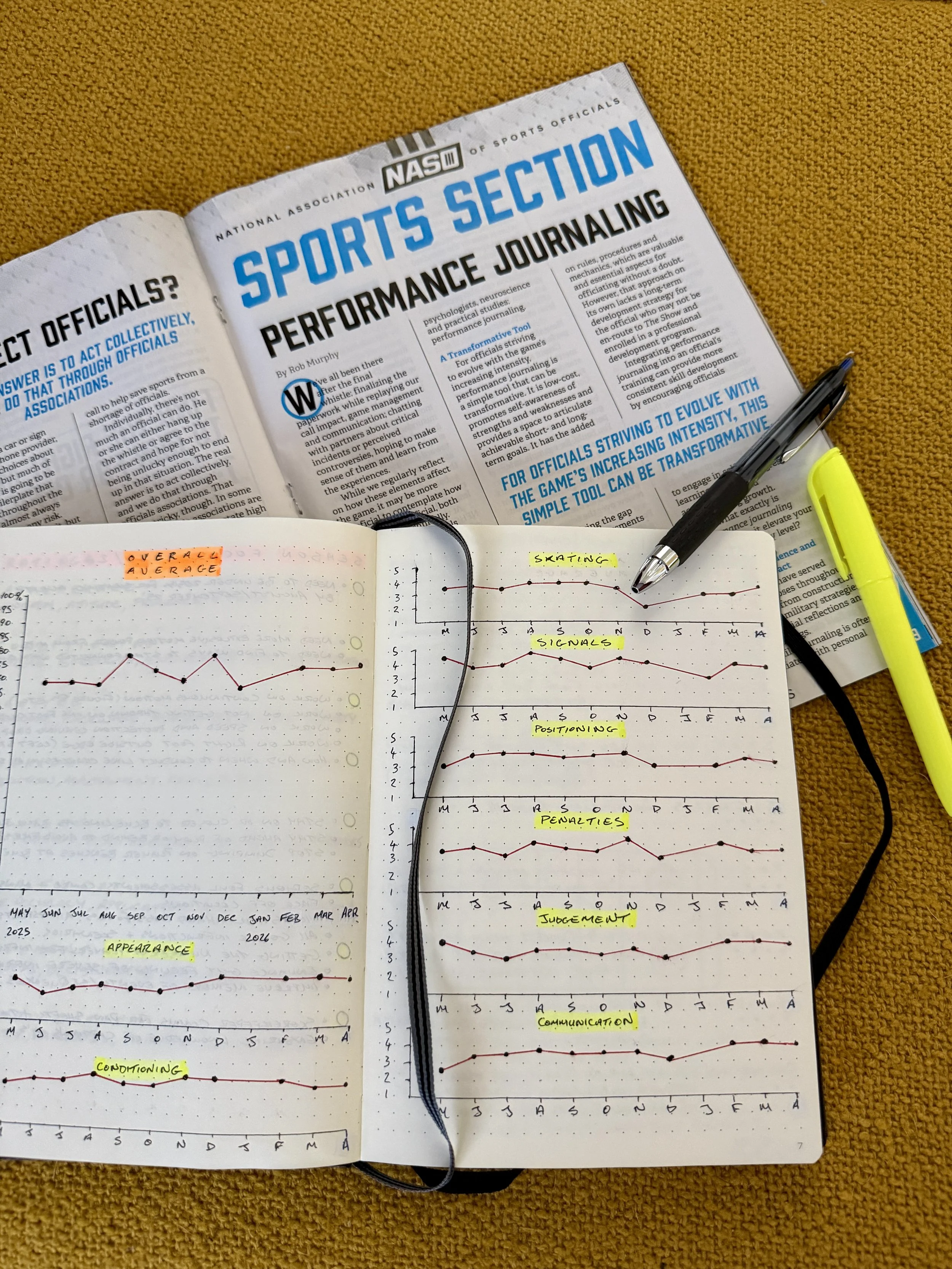
REF’S CREASE
We’ve all been there after the final whistle; Finalizing the paperwork while replaying our call impact, game management and communication; chatting with our partners about critical incidents or perceived controversies, hoping to make sense of it and learn from the experience.
While we regularly reflect on how these elements affect the game, it may be more beneficial to contemplate how it affects the official, both mentally and technically.
It’s natural for officials to internally debrief their performance with the hope of leveraging any insights to improve. Unfortunately, over a long season, translating that volume of information into actionable growth can be challenging- even when players and spectators regularly help out by telling you exactly what you need to work on!
Officials are not alone in this. Many elite athletes and Olympic medalists face similar hurdles. It is no surprise they explore every possible advantage for improvement.
One method of self-evaluation and performance tracking has been used to great success by top athletes and is endorsed by sports psychologists, neuroscience, and practical studies: Performance Journaling.
For officials striving to evolve with the game’s increasing intensity, this simple tool can be transformative.
Performance journaling is low-cost, promotes self-awareness of strengths and weaknesses and provides a space to articulate achievable short and long-term goals. It has the added benefit of bridging the gap between formal assessments by your local association. Consistent self-evaluation can offer performance insights that annual or semi annual game feedback from an assessor simply can’t provide given their format.
Using Performance Journaling for consistent self-evaluation offers an aggregated reading of your performance over a longer stretch of time; not just the infrequent games where you may have formal mentoring.
Most officiating development programs focus on rules, procedures and mechanics - valuable and essential aspects for officiating without a doubt. However, that approach on its own lacks a long-term development strategy for the official who may not be en-route to The Show and enrolled in a professional development program.
Integrating performance journaling into an official’s training can provide more consistent skill development by encouraging officials to engage in self-directed learning, tracking progress across seasons and personalizing growth..
So, what exactly is Performance Journaling and how can it elevate your officiating at any level?

‘PERFORMANCE JOURNALING’
Article originally published in Referee Magazine by National Association of Sports Officials (NASO) June 2026.
Philosophy, Science & Impact
Journals have served many purposes throughout history- from construction maps and military strategies to existential reflections and personal logs.
While journaling is often associated with personal reflection, its value as a performance-enhancing tool has gained traction among sports psychologists and elite performers over the past decade
Olympians, NFL players, and self-development experts have promoted journaling as a powerful way to build self-awareness and overcome setbacks.
While there are a number of ways successful athletes and specialists approach journaling, for officials, one approach stands out, Targeted Reflection.
Targeted Reflection is a method of using structured prompts to address specific goals.
Recent studies have found that officials who engage in reflective writing are better equipped to manage the emotional toll of the job while processing performance information; enhancing the official’s ability to regulate stress and maintain focus. It’s not simply cathartic- it’s strategic.
So how can you use Targeted Reflection to understand your game and improve performance?
How-To Start Your Performance Journal
What do I need?
Just a pen and notebook.
What kind of notebook works best?
Anything larger than a pocket notepad. Hardcover notebooks are ideal- they can withstand the wear and tear of your gear bag. Dotted or plain pages are more versatile than ruled ones, allowing you to sketch rink, court or field diagrams freely.
How do I customize it to my sport and goals?
Start with your association’s or sport’s assessment criteria. You should grade yourself, on a technical level, against what is seen as the standard for your specific sport at your officiating level. You can usually find these criteria online. Your local officiating association can also provide you with this information. Ask them for an example of an official assessment for your level of officiating.
How should I rate my performances?
Create a personal scoring metric based on the grading standards outlined by your sport’s officiating criteria Concentrate on defining the criteria, understanding it, and being consistent in how you grade each aspect of your performance game after game. You could for example, rate each performance area out of 5 and calculate your performance percentage each game for a single number. That way you have individual data points and an overall score to review over the season.
What layout works best?
Here’s a suggested structure to get you started. Feel free to adapt it as your focus evolves or as you move through the levels. You can also enhance it with tracking charts related to your ratings. A good base is to have your long term goals reflected in your focus points for your season.
Suggested Layout
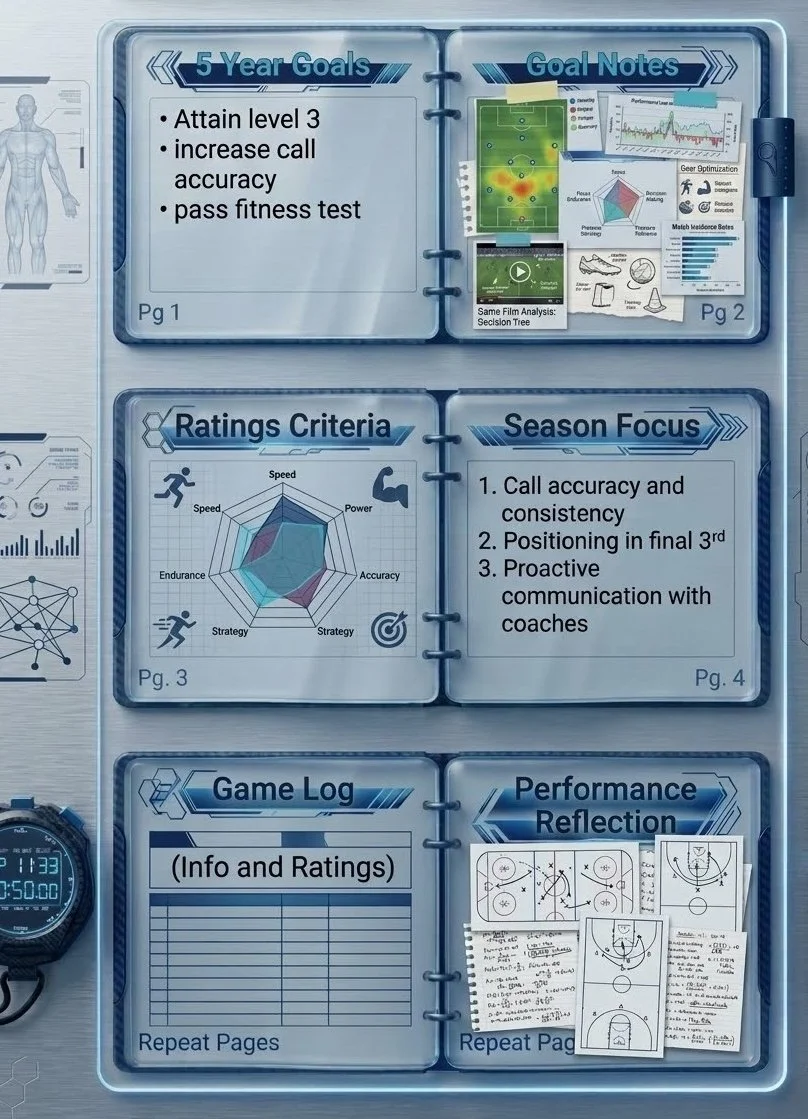
Modify your approach to your journal to make sure your goals and methods are aligned with your associations expectations, performance evaluation criteria while leaving space for reflection and positive self-critique.
Post-Game Report
Today’s game increases in speed by the season. Players are quicker, decisions are scrutinized instantly and, on average, officials have considerably less resources than athletes to keep up. A performance journal can supplement your formal training and assessments as your personal replay system, your training partner and development coach. As an official, you want to do the best job you can, with what you have. Starting a performance journal can help you get to the next level, by better understanding your level.
Rob Murphy
